B.J. Johnson stood firmly in place with his hands behind his back on the outskirts of the Carmelo K. Anthony Basketball Center gym during media day on Oct. 18.
From his standard, squeaky-clean white, size 14 Jordans up to his No. 2 jersey and orange headband, everything was traditional. No Ron Patterson wacky hair. No DaJuan Coleman outlandish tattoos. No Jerami Grant irreversible grin.
His mother Sharon Dash watched intently from two feet to his right. Johnson’s aunt, uncle and cousin surrounded her. Dash listened as her son mentioned that he can’t swim, his favorite villain is the Joker and he loves any kind of rice.
She knew all of that. But a more challenging question stumped her.
“What’s the most fascinating thing about B.J.?” a reporter asked.
She seemed puzzled by the question. She said she misses her “sweetheart” dearly while he’s at school. When she first opened the door to the Melo Center, she said, “Where’s my son? Where’s my son?” And she loved going to every one of his games at Lower Merion High School in Pennsylvania.
But she couldn’t pinpoint anything that stood out about him.
“He’s just such a plain kid,” Dash said. “Baby, you’ve got to get interesting.”
Then Johnson flashed a golden smile, revealing a slight gap between his two front teeth. He swayed back and forth, clearly uncomfortable by the entire situation. Johnson, who’s only 17, is as quiet as they come, according to his relatives. But his reserved nature and tendency to fly under the radar made him lethal in high school and may help him earn a spot in the Syracuse rotation.
The banter continued. Dash and her sister Michelle Scott quipped about just how quiet Johnson is.
“I think he talks too much,” Scott said.
“Noooo,” Dash responded, incredulously looking at her sister, taking a step back and jerking her head downward in disbelief.
“I was being facetious,” Scott responded wryly.
But Johnson’s father Bobby Johnson, who played professional basketball in Portugal and Germany, is the antithesis of quiet. When Bobby grew up in South Philadelphia, the culture was completely different. Jawing and trash talk was incessant. It was the expectation. You had to go out there and play and shut those people up, Bobby Johnson said. If you didn’t, you’d never come back on the floor again.
Johnson and his father used to wake up at 6 a.m. and head to Lower Merion to work out for an hour. Johnson was dedicated throughout, Bobby said, but he didn’t always show enthusiasm on the court.
“At one point in time I thought you had to stick a pin in him to get him to wake up,” Bobby Johnson said. “He was always laid back, and I would always tell him, ‘When you come out on the floor, we don’t need that cool sh*t.’”
He didn’t hear his son swear until he was 15 or 16.
“I think the first time I actually heard him yell out the four-letter word he was playing at one of the practices and he was like ‘F*ck!’” Bobby Johnson said. “I was like, ‘OK, you do care.’”
Before Lower Merion’s state championship game against Chester (Pa.) High School, Johnson and his father drove to the rehabilitation center because Johnson had sprained his ankle and needed treatment. Bobby tried to elicit some sort of enthusiasm out of his son — to make sure he was ready for the biggest game of his high school career.
After losing to Chester three years in a row, Johnson and the Aces were out for revenge. But Johnson was calm, unfazed by the pressure of the situation.
“I got ‘em, dad,” he said coolly.
“He got ‘em!” Bobby said. Lower Merion beat Chester 63-47, ending the Clippers’ 78-game in-state winning streak. Johnson finished with 22 points and 11 rebounds. But the fire was never fully there.
When Bobby Johnson first watched his son play at Lower Merion, he sat there wondering if the other fans would get riled up like he did.
“When I first went to the games, the Lower Merion people are sitting there like it’s a cricket match,” Bobby said. “I remember being like, ‘What the — ain’t anybody going to get the guys going?’”
Months later, removed from one of the most dominant stints at Lower Merion since Kobe Bryant’s hey-day, Johnson comes to SU as the No. 17 small forward in the class of 2013. Yet on media day, few reporters come his way. He stands far from the center of attention as reporters crowd around stars C.J. Fair and Grant.
Most people don’t expect Johnson to play much this season. He may not. But his quiet confidence will help prepare him if he does. He’s not a blue-chipper, 5-star guy, Bobby said, but he works every day.
“Sometimes it’s better to be that guy that comes in under the radar and just does what he needs to do,” Bobby said. “Then all of a sudden everybody’s saying, ‘I knew he would be that guy.’”
Bobby Johnson recalls asking his son a question back in high school.
“It was funny because I asked B.J., ‘Suppose this summer you really blew up and had Roy Williams knocking on your door. Would you want to go to North Carolina?
“And he was like, ‘No.’
“I said ‘If Coach K was knocking on your door, would you want to go to Duke?’
“And he was like, ‘No.’
“He had a plan, and it’s what he wanted to do.”
Now Johnson’s ready to live out the dream he has had since seventh grade: star at Syracuse. Jim Boeheim said Johnson has surprised the coaching staff up to this point. He’s young, but he can ball.
“I’m just really excited to be here and for the season to start,” Johnson said. “That’s pretty much all I’ve been waiting for and now it’s here.”
Published on November 6, 2013 at 3:28 am
Contact Trevor: tbhass@syr.edu | @TrevorHass
Monday, April 13, 2015

Lamolinara excels in goal with help of jokester, erratic Daly
When Dominic Lamolinara walks out on the field before Saturday’s game against Princeton, he’ll know a familiar face will be firing shots his way in warm-ups.
Syracuse reserve Brenny Daly has become Lamolinara’s go-to warm-up guy this year after Lamolinara struggled to find a shooter that suited his needs last season. Daly’s erratic, unpredictable shot and his outlandish personality have helped Lamolinara earn the starting nod in net and improve his game all season. The duo will head out to the field once again on Saturday when No. 8 Syracuse (6-2, 2-1 Big East) faces No. 7 Princeton (6-2, 2-1 Ivy League) at Princeton Stadium in New Jersey.
“Dom and I have a great relationship,” Daly said. “We’re really good friends on and off the field. He’s playing great. He credits me a little bit, which I’ll take, but he’s playing awesome.”
Lamolinara and Daly first met in high school in the Baltimore area. Lamolinara was a standout goalie at St. Mary’s and Daly was a dominant midfielder at McDonogh, two schools that are approximately 40 miles away from each other. Daly redshirted last season and Lamolinara, after transferring from Maryland, started three games for Syracuse, splitting time with Bobby Wardwell.
Lamolinara struggled all season to find a warm-up guy that was exactly what he was looking for. Billy Ward, Dylan Donahue and Henry Schoonmaker, three of SU’s most prolific scorers, all gave it a shot.
But there was something wrong. They were all too accurate. They placed their shots exactly where Lamolinara asked them to. He wanted more unpredictability ― someone he could count on to do the exact opposite of what he expected: Daly.
The always-grinning, always-joking, often-bearded 5-foot-10-inch reserve. He’s only played three games this season, but every time Lamolinara trots onto the field prior to the opening faceoff, Daly’s the one rifling shots at him.
Lamolinara requested Daly in the fall. They had been friends and gotten along swimmingly, so Lamolinara figured he’d be a perfect choice for the job. Now they hang out off the field all the time, chowing down at Chipotle whenever possible.
“We always had that relationship,” Lamolinara said. “We were the Baltimore boys.”
Lamolinara remembers the first day of fall practice, a frigid Saturday. He and Daly were starting to develop even more of a rapport. Lamolinara was freezing, so he told Daly not to hit him with the ball.
Daly did not oblige. He rarely does. Daly, who Lamolinara called “the John Belushi of the team,” is always making a wisecrack or pulling a prank.
“He hit me and he hit me like three or four times,” Lamolinara said. “It kind of pissed me off. He was laughing. He thought it was hilarious.”
Daly isn’t only unpredictable when he tries to be, though. Lamolinara said if he asks for a shot top-right it will often go bottom-right. Daly can fire the ball at an absurdly fast speed, but he has very little control, Lamolinara said.
And that’s exactly what the goalie needs. So far the results have been tremendous. Lamolinara has replaced Wardwell as Syracuse’s starting goalie, allowing just 6.77 goals per game and saving 60.4 percent of shots that come his way, close to the best in the country.
Daly often apologizes repeatedly when he’s having a bad day and his shots are way off target, but Lamolinara always tells him to stop. It helps.
“I just tell him to calm down, it’s good, it’s helping me out,” Lamolinara said. “I think it’s taken six months for him to finally believe it.”
Daly even scored his first career goal against Providence, firing a shot from close to 17 yards out that elicited an uproar from the bench.
Lamolinara said Daly started running back on defense because he had no idea the shot went in. Then he heard the commotion from the bench and reveled in the glory as his teammates went crazy.
“Everybody loves Brenny. I couldn’t really explain it,” Lamolinara said. “He’s just that funny kid on the team. When he does well, everybody gets really excited.”
Ward loves playing with Daly, too. He said Daly is so outgoing that he could talk to a wall.
“If you left Brenny by himself with a wall he’d have a great time with it,” Ward said. “If you left him a half hour by himself he’d be having the time of his life. That’s just the kind of guy he is.”
Daly and Lamolinara chat before every practice and every game. Daly fires close to 65 shots. Lamolinara saves them ― two-thirds of them, Daly said ― as the two joke around for 15 minutes.
“I finally found a warm-up guy that I like,” Lamolinara said. “I’m sure I’ll keep him throughout the year. I’ll probably keep him next year as well.”
Published on April 4, 2013 at 1:26 am
Contact Trevor: tbhass@syr.edu | @TrevorHass
Syracuse reserve Brenny Daly has become Lamolinara’s go-to warm-up guy this year after Lamolinara struggled to find a shooter that suited his needs last season. Daly’s erratic, unpredictable shot and his outlandish personality have helped Lamolinara earn the starting nod in net and improve his game all season. The duo will head out to the field once again on Saturday when No. 8 Syracuse (6-2, 2-1 Big East) faces No. 7 Princeton (6-2, 2-1 Ivy League) at Princeton Stadium in New Jersey.
“Dom and I have a great relationship,” Daly said. “We’re really good friends on and off the field. He’s playing great. He credits me a little bit, which I’ll take, but he’s playing awesome.”
Lamolinara and Daly first met in high school in the Baltimore area. Lamolinara was a standout goalie at St. Mary’s and Daly was a dominant midfielder at McDonogh, two schools that are approximately 40 miles away from each other. Daly redshirted last season and Lamolinara, after transferring from Maryland, started three games for Syracuse, splitting time with Bobby Wardwell.
Lamolinara struggled all season to find a warm-up guy that was exactly what he was looking for. Billy Ward, Dylan Donahue and Henry Schoonmaker, three of SU’s most prolific scorers, all gave it a shot.
But there was something wrong. They were all too accurate. They placed their shots exactly where Lamolinara asked them to. He wanted more unpredictability ― someone he could count on to do the exact opposite of what he expected: Daly.
The always-grinning, always-joking, often-bearded 5-foot-10-inch reserve. He’s only played three games this season, but every time Lamolinara trots onto the field prior to the opening faceoff, Daly’s the one rifling shots at him.
Lamolinara requested Daly in the fall. They had been friends and gotten along swimmingly, so Lamolinara figured he’d be a perfect choice for the job. Now they hang out off the field all the time, chowing down at Chipotle whenever possible.
“We always had that relationship,” Lamolinara said. “We were the Baltimore boys.”
Lamolinara remembers the first day of fall practice, a frigid Saturday. He and Daly were starting to develop even more of a rapport. Lamolinara was freezing, so he told Daly not to hit him with the ball.
Daly did not oblige. He rarely does. Daly, who Lamolinara called “the John Belushi of the team,” is always making a wisecrack or pulling a prank.
“He hit me and he hit me like three or four times,” Lamolinara said. “It kind of pissed me off. He was laughing. He thought it was hilarious.”
Daly isn’t only unpredictable when he tries to be, though. Lamolinara said if he asks for a shot top-right it will often go bottom-right. Daly can fire the ball at an absurdly fast speed, but he has very little control, Lamolinara said.
And that’s exactly what the goalie needs. So far the results have been tremendous. Lamolinara has replaced Wardwell as Syracuse’s starting goalie, allowing just 6.77 goals per game and saving 60.4 percent of shots that come his way, close to the best in the country.
Daly often apologizes repeatedly when he’s having a bad day and his shots are way off target, but Lamolinara always tells him to stop. It helps.
“I just tell him to calm down, it’s good, it’s helping me out,” Lamolinara said. “I think it’s taken six months for him to finally believe it.”
Daly even scored his first career goal against Providence, firing a shot from close to 17 yards out that elicited an uproar from the bench.
Lamolinara said Daly started running back on defense because he had no idea the shot went in. Then he heard the commotion from the bench and reveled in the glory as his teammates went crazy.
“Everybody loves Brenny. I couldn’t really explain it,” Lamolinara said. “He’s just that funny kid on the team. When he does well, everybody gets really excited.”
Ward loves playing with Daly, too. He said Daly is so outgoing that he could talk to a wall.
“If you left Brenny by himself with a wall he’d have a great time with it,” Ward said. “If you left him a half hour by himself he’d be having the time of his life. That’s just the kind of guy he is.”
Daly and Lamolinara chat before every practice and every game. Daly fires close to 65 shots. Lamolinara saves them ― two-thirds of them, Daly said ― as the two joke around for 15 minutes.
“I finally found a warm-up guy that I like,” Lamolinara said. “I’m sure I’ll keep him throughout the year. I’ll probably keep him next year as well.”
Published on April 4, 2013 at 1:26 am
Contact Trevor: tbhass@syr.edu | @TrevorHass
Monday, September 9, 2013
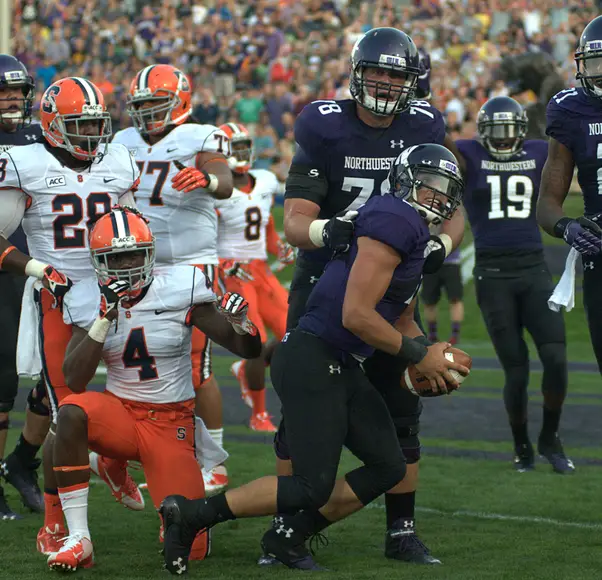
Courtesy of Susan Du/The Daily Northwestern
Northwestern
quarterback Kain Colter celebrates as cornerback Brandon Reddish (4)
and the rest of the Syracuse defense look on. Colter rushed for 102
yards to go along with 116 through the air.
CATASTROPHE: Syracuse unable to slow Northwestern offense in rout
EVANSTON, Ill. — It was as if Kain Colter and Brandon Reddish were stuck together by Elmer’s glue.
Neither budged. Neither mustered up extra juice as the Northwestern quarterback and Syracuse cornerback fused into one blob less than six inches away from the goal line.
But Colter improvised and outwitted the Syracuse defense, as he did all game. He simply stuck the ball past Reddish’s left ear and into the end zone. Touchdown, Northwestern.
The Wildcat offense toyed with and out-crafted the Orange defense all night, propelling No. 19 Northwestern (2-0) to a 48-27 win over Syracuse (0-2) at Ryan Field in Evanston, Ill., on Saturday in front of 38,033. Colter and Trevor Siemian provided a dynamic one-two quarterback punch that the Orange defense couldn’t handle. Even playing without running back Venric Mark, the Wildcats athletes torched SU all night long.
“Just a tough night,” Syracuse defensive tackle Jay Bromley said.
That brilliant goal-line maneuver by Colter upped Northwestern’s lead to 27-7 with 2:38 left in the first half. After scrambling more than 15 yards and weaving through Syracuse defenders like they were stuck in sand, Colter simply did what he had to do to score.
He made the right play. Just like he did all night, and just like his entire team did.
Syracuse head coach Scott Shafer said the one thing Syracuse couldn’t afford to do was give Northwestern opportunities.
“And we damn well did,” he said.
The beatdown started in the first 51 seconds of the game. Four plays, four completions. Two catches, a facemask penalty and two more catches. All in less than a minute.
And the bleeding didn’t stop there. Siemian came in and bumped the lead to 17-0 just 2:22 into the second quarter. After throwing three passes in a row to Tony Jones for 47 total yards, Siemian delivered a 20-yard strike to Dan Vitale for a touchdown. The rout was on, and it was just beginning.
Anyone who tried to contain Jones failed miserably. Keon Lyn and Reddish both slotted up against him, and both got burned. Jones finished with nine receptions for 185 yards and a touchdown.
A week after Penn State wide receiver Allen Robinson laid down a beating on the Syracuse defense, Jones followed suit.
And on the rare instance that the defense had Jones locked up downfield, Colter made plays with his feet.
With Northwestern leading 20-7, SU linebackers Dyshawn Davis and Cameron Lynch pursued Colter in the backfield. A sack seemed inevitable, but Colter escaped once again.
He danced his way through the defense for a 33-yard gain before Bromley eventually wrapped him up.
“He’s as advertised,” Bromley said. “He’s a mobile quarterback. He’s elusive, and he’s a hard guy to tackle.”
And then there was Siemian – the more polished thrower of the two. His touchdown pass to Christian Jones with two seconds left in the first half essentially iced the game.
There was no way Syracuse was coming back from a 34-7 halftime deficit — not the way Colter and Siemian were playing. Not the way the Syracuse defense was visibly exhausted in the second quarter.
Syracuse’s secondary looked winded. The Orange had taken a good, old-fashioned whooping.
“Everyone’s going to point at the quarterback position,” Shafer said, “but goddamn it, it was both sides of the ball.”
NU’s numbers speak for themselves: 270 passing yards, 6-for-6 in the red zone, 22-of-24 passes completed — all in the first half.
Compare that to 119 passing yards for Syracuse, only one trip to the red zone, and SU’s seven incompletions and the glaring gap on the scoreboard doesn’t sound so unfathomable.
“They’re just good,” Syracuse defensive coordinator Chuck Bullough said.
In fact, Northwestern was so good that Shafer told his team at the break to come out and win the second half — not the game, but merely the final 30 minutes.
Syracuse did, but it still lost the game.
The frame was merely a formality. Colter, Siemian and Jones had wreaked all the havoc they needed to wreak. The damage was done, and so were Syracuse’s hopes at an upset.
Colter finished with 87 rushing yards and 116 passing yards while Siemian threw for 259 yards and three touchdowns. It was a golden combination – one that’s been talked about for Syracuse, but one
Shafer hasn’t implemented quite yet.
That combination sent Syracuse packing halfway across the country with a 0-2 record.
Said Shafer: “We played a poor football game.”
Contact Trevor: tbhass@syr.edu | @TrevorHass
Neither budged. Neither mustered up extra juice as the Northwestern quarterback and Syracuse cornerback fused into one blob less than six inches away from the goal line.
But Colter improvised and outwitted the Syracuse defense, as he did all game. He simply stuck the ball past Reddish’s left ear and into the end zone. Touchdown, Northwestern.
The Wildcat offense toyed with and out-crafted the Orange defense all night, propelling No. 19 Northwestern (2-0) to a 48-27 win over Syracuse (0-2) at Ryan Field in Evanston, Ill., on Saturday in front of 38,033. Colter and Trevor Siemian provided a dynamic one-two quarterback punch that the Orange defense couldn’t handle. Even playing without running back Venric Mark, the Wildcats athletes torched SU all night long.
“Just a tough night,” Syracuse defensive tackle Jay Bromley said.
That brilliant goal-line maneuver by Colter upped Northwestern’s lead to 27-7 with 2:38 left in the first half. After scrambling more than 15 yards and weaving through Syracuse defenders like they were stuck in sand, Colter simply did what he had to do to score.
He made the right play. Just like he did all night, and just like his entire team did.
Syracuse head coach Scott Shafer said the one thing Syracuse couldn’t afford to do was give Northwestern opportunities.
“And we damn well did,” he said.
The beatdown started in the first 51 seconds of the game. Four plays, four completions. Two catches, a facemask penalty and two more catches. All in less than a minute.
And the bleeding didn’t stop there. Siemian came in and bumped the lead to 17-0 just 2:22 into the second quarter. After throwing three passes in a row to Tony Jones for 47 total yards, Siemian delivered a 20-yard strike to Dan Vitale for a touchdown. The rout was on, and it was just beginning.
Anyone who tried to contain Jones failed miserably. Keon Lyn and Reddish both slotted up against him, and both got burned. Jones finished with nine receptions for 185 yards and a touchdown.
A week after Penn State wide receiver Allen Robinson laid down a beating on the Syracuse defense, Jones followed suit.
And on the rare instance that the defense had Jones locked up downfield, Colter made plays with his feet.
With Northwestern leading 20-7, SU linebackers Dyshawn Davis and Cameron Lynch pursued Colter in the backfield. A sack seemed inevitable, but Colter escaped once again.
He danced his way through the defense for a 33-yard gain before Bromley eventually wrapped him up.
“He’s as advertised,” Bromley said. “He’s a mobile quarterback. He’s elusive, and he’s a hard guy to tackle.”
And then there was Siemian – the more polished thrower of the two. His touchdown pass to Christian Jones with two seconds left in the first half essentially iced the game.
There was no way Syracuse was coming back from a 34-7 halftime deficit — not the way Colter and Siemian were playing. Not the way the Syracuse defense was visibly exhausted in the second quarter.
Syracuse’s secondary looked winded. The Orange had taken a good, old-fashioned whooping.
“Everyone’s going to point at the quarterback position,” Shafer said, “but goddamn it, it was both sides of the ball.”
NU’s numbers speak for themselves: 270 passing yards, 6-for-6 in the red zone, 22-of-24 passes completed — all in the first half.
Compare that to 119 passing yards for Syracuse, only one trip to the red zone, and SU’s seven incompletions and the glaring gap on the scoreboard doesn’t sound so unfathomable.
“They’re just good,” Syracuse defensive coordinator Chuck Bullough said.
In fact, Northwestern was so good that Shafer told his team at the break to come out and win the second half — not the game, but merely the final 30 minutes.
Syracuse did, but it still lost the game.
The frame was merely a formality. Colter, Siemian and Jones had wreaked all the havoc they needed to wreak. The damage was done, and so were Syracuse’s hopes at an upset.
Colter finished with 87 rushing yards and 116 passing yards while Siemian threw for 259 yards and three touchdowns. It was a golden combination – one that’s been talked about for Syracuse, but one
Shafer hasn’t implemented quite yet.
That combination sent Syracuse packing halfway across the country with a 0-2 record.
Said Shafer: “We played a poor football game.”
Contact Trevor: tbhass@syr.edu | @TrevorHass
Thursday, August 29, 2013
True grit: Shafer implements ‘hard-nosed’ culture at Syracuse in 1st year as head coach in ACC
Three yards and a cloud of dust. That’s the way Syracuse starts every practice.
The offense tries to move the ball three yards in three downs while the defense vehemently tries to impede its progress. The winner revels in the glory while the loser is punished with up-downs.
It’s a drill that first-year head coach Scott Shafer learned from legendary Ohio State coach Woody Hayes while growing up in Northeast Ohio. When Shafer played quarterback for his father, Ron, at Riverside High School in Painesville, the practice fields were all mud, dirt and dust.
Shafer knew that when he became a head coach – a job he’s wanted since before college – he’d make sure his team used three yards and a cloud of dust.
“It’s a frickin’ war,” Shafer said.
The drill epitomizes the brand of football Shafer wants his team to play in its first year in the Atlantic Coast Conference. The Orange will rely on “hard-nosed” football – as Shafer has dubbed it – to succeed. It’s a phrase he has uttered frequently in his first eight months as head coach, while mastering his already adept visor toss and assembling a crew of assistant coaches equally fiery and focused.
Syracuse doesn’t have the raw talent that teams like No. 8 Clemson and No. 11 Florida State possess, but Shafer hopes intensity, relentlessness and toughness will be enough to compete. He expects passion to emanate from every drill, every workout and every game.
“We may not be as big, we may not be as fast,” Shafer said, “but doggonit, we want to play a style of football where we’re knocking the hell out of people and playing a hard-nosed game.”
Defensive line coach Tim Daoust knows all about hard-nosed football. He’s known Shafer for 12 years and believes in his relentless approach. That’s why Daoust unremittingly yells at his players – he feels the intensity will prepare them for the regular season. It’s why he lost his voice just three days into training camp.
During an Aug. 20 practice, the defense jumped offsides during a live-game simulation of a field goal. Shafer lost it.
He threw his trademark white, wide-brimmed visor on the ground in disgust. Those nuances and “controlling the controllables,” as Shafer puts it, are what he believes will determine the team’s success.
Daoust said the visor toss isn’t a new element in Shafer’s repertoire.
When Shafer was a defensive coordinator at Western Michigan, his players even made a compilation video of his best visor tosses.
“The county fair’s this week, right?” Daoust said, completely straight-faced. “We could take him to the fair and he could knock down those little milk pints or whatever they are.”
Much like Daoust, offensive line coach Pat Perles rarely lets his players off the hook. If they make a mistake, they’re always held accountable.
“F*ck you guys,” he yelled to his linemen moments after completing a Shafer-esque hat chuck. They stopped pushing forward into the cushiony orange mats before Perles deemed the drill finished.
Syracuse center Macky MacPherson detailed one drill during which Perles has his players grab 35-pound sand bags, squat and shuffle their feet. Five reps. Twenty seconds per rep. Shafer said games are won in the trenches. Drills like those showcase the hard-nosed mentality he’s tried to infuse into the Orange’s culture.
“It’s not just a gimmick,” MacPherson said. “It’s something Coach Shafer really does believe in.”
Shafer’s wife, Missy, said she hears the phrase all the time: “Don’t you change.”
The Shafers still live in the same house despite Shafer’s promotion. Missy Shafer still shops at Wegmans with a baseball hat, no makeup and a mismatched shirt and shorts.
Just because the team lost a crop of stellar seniors – including star quarterback Ryan Nassib –doesn’t mean it has to change its ways. The approach is unwavering. Do what’s gotten you this far and you’ll be fine.
So they won’t alter too much. But the question remains whether staying the same and being mentally and physically tough will be enough.
The team has bought in. MacPherson described the Orange as an “intense, ground-and-pound, we’re-gonna-impose-our-will-on-you kind of team.”
“#Hard-nosed,” MacPherson said. “It’s nose to the grindstone, blue collar, anything you can possibly imagine. Outwork your opponent and beat him down while you do it.”
It’s no secret. ACC teams are faster, stronger and certainly more skilled from top to bottom than Big East teams. Shafer knows Syracuse is in for a tall task. Doug Marrone’s departure to the Buffalo Bills in January left unanswered questions, and made the conference switch even more daunting.
The Orange is the underdog. But Assistant Athletics Director for Athletic Performance Will Hicks said that’s just fine.
“I think Coach Shafe embraces being the underdog a little bit,” Hicks said. “It gets him fired up.”
That’s who he is. Praise from his players, assistant coaches and wife is consistent. The 46-year-old Shafer’s fusion of passion and compassion is showcased in everything he does, and that blend seems to have permeated throughout the entire team.
One of the staples of Shafer’s approach is that he always holds people accountable and never lets them feel sorry for themselves. When Missy Shafer was diagnosed with malignant melanoma – the deadliest form of skin cancer – while the family lived in Michigan more than four years ago, Shafer told her not to feel sorry for herself. He supported her and helped her, never letting her give up.
“This is unfortunate, it’s tough, but it’s life,” Missy Shafer said. “It’s how you handle it and how you get through it.”
And she did. After getting surgery at one of the premier melanoma-treating hospitals in the country, the cancer was history.
Ups and downs will come in the ACC – just like they did in Missy’s case and in the Big East. It’s a matter of staying resolute and bouncing back.
Shafer took training camp as an opportunity to see how players responded to adversity. He said he was most proud of the team last season, when it dug itself out of a 2-4 start to finish 8-5 by not changing its approach and continuing to plow forward with determination.
Change is the only constant in Syracuse, but Shafer said his team is up for the challenge. He’s not concerned that SU was picked sixth out of seven in its division. He’s more preoccupied with ensuring the Orange finishes on top, despite the seemingly infinite mountain ahead.
“It’s a challenge that we relish,” Shafer said. “We’re not afraid of anybody at Syracuse. Never have been.”
Never back down. Put in the effort and control the controllables by playing hard-nosed football. The rest will work itself out.
“He wants things to be done the right way,” Hicks said, “but it’s all in a positive approach. He’s not going to accept things not being right. There’s no gray.”
Defensive tackle Jay Bromley laughed when asked how many times Shafer says the phrase “hard-nosed” in a typical practice.
“Hard-nosed,” Bromley said, scratching his chin. “Hard-nosed. Anywhere between five,” Bromley paused and laughed again, “and 20. It depends on how we’re playing.”
Bromley said Shafer has to yell at both the offense and defense now, which means he’s shouting “hard-nosed” twice as much as he did as Syracuse’s defensive coordinator.
Even the team meetings are more intense, running back Jerome Smith said, with Shafer at the helm.
“His press conference made someone want to go out and play for him right now,” Smith said. “He has everybody fired up.”
The team believes in Shafer’s approach. Syracuse is confident it can shock some teams. The Orange opens the season against Penn State and No. 22 Northwestern. It faces national title contender Clemson just three games later.
That doesn’t faze Bromley, though. He said confidence is soaring and the players truly believe they can leave a dent in the conference. When asked about his realistic goal for the season, Bromley said he wanted Syracuse to win the ACC championship.
It sounds farfetched to an outsider, but those inside the bubble are starting to believe in Shafer’s ways. Maybe they can shock the world.
If Syracuse finds itself in a third-and-goal situation with the ball on the three in the game’s waning minutes, Shafer hopes both the offense and defense will know exactly what to do.
Finish how they start every practice – three yards and a cloud of dust.
The offense tries to move the ball three yards in three downs while the defense vehemently tries to impede its progress. The winner revels in the glory while the loser is punished with up-downs.
It’s a drill that first-year head coach Scott Shafer learned from legendary Ohio State coach Woody Hayes while growing up in Northeast Ohio. When Shafer played quarterback for his father, Ron, at Riverside High School in Painesville, the practice fields were all mud, dirt and dust.
Shafer knew that when he became a head coach – a job he’s wanted since before college – he’d make sure his team used three yards and a cloud of dust.
“It’s a frickin’ war,” Shafer said.
The drill epitomizes the brand of football Shafer wants his team to play in its first year in the Atlantic Coast Conference. The Orange will rely on “hard-nosed” football – as Shafer has dubbed it – to succeed. It’s a phrase he has uttered frequently in his first eight months as head coach, while mastering his already adept visor toss and assembling a crew of assistant coaches equally fiery and focused.
Syracuse doesn’t have the raw talent that teams like No. 8 Clemson and No. 11 Florida State possess, but Shafer hopes intensity, relentlessness and toughness will be enough to compete. He expects passion to emanate from every drill, every workout and every game.
“We may not be as big, we may not be as fast,” Shafer said, “but doggonit, we want to play a style of football where we’re knocking the hell out of people and playing a hard-nosed game.”
Defensive line coach Tim Daoust knows all about hard-nosed football. He’s known Shafer for 12 years and believes in his relentless approach. That’s why Daoust unremittingly yells at his players – he feels the intensity will prepare them for the regular season. It’s why he lost his voice just three days into training camp.
During an Aug. 20 practice, the defense jumped offsides during a live-game simulation of a field goal. Shafer lost it.
He threw his trademark white, wide-brimmed visor on the ground in disgust. Those nuances and “controlling the controllables,” as Shafer puts it, are what he believes will determine the team’s success.
Daoust said the visor toss isn’t a new element in Shafer’s repertoire.
When Shafer was a defensive coordinator at Western Michigan, his players even made a compilation video of his best visor tosses.
“The county fair’s this week, right?” Daoust said, completely straight-faced. “We could take him to the fair and he could knock down those little milk pints or whatever they are.”
Much like Daoust, offensive line coach Pat Perles rarely lets his players off the hook. If they make a mistake, they’re always held accountable.
“F*ck you guys,” he yelled to his linemen moments after completing a Shafer-esque hat chuck. They stopped pushing forward into the cushiony orange mats before Perles deemed the drill finished.
Syracuse center Macky MacPherson detailed one drill during which Perles has his players grab 35-pound sand bags, squat and shuffle their feet. Five reps. Twenty seconds per rep. Shafer said games are won in the trenches. Drills like those showcase the hard-nosed mentality he’s tried to infuse into the Orange’s culture.
“It’s not just a gimmick,” MacPherson said. “It’s something Coach Shafer really does believe in.”
Shafer’s wife, Missy, said she hears the phrase all the time: “Don’t you change.”
The Shafers still live in the same house despite Shafer’s promotion. Missy Shafer still shops at Wegmans with a baseball hat, no makeup and a mismatched shirt and shorts.
Just because the team lost a crop of stellar seniors – including star quarterback Ryan Nassib –doesn’t mean it has to change its ways. The approach is unwavering. Do what’s gotten you this far and you’ll be fine.
So they won’t alter too much. But the question remains whether staying the same and being mentally and physically tough will be enough.
The team has bought in. MacPherson described the Orange as an “intense, ground-and-pound, we’re-gonna-impose-our-will-on-you kind of team.”
“#Hard-nosed,” MacPherson said. “It’s nose to the grindstone, blue collar, anything you can possibly imagine. Outwork your opponent and beat him down while you do it.”
It’s no secret. ACC teams are faster, stronger and certainly more skilled from top to bottom than Big East teams. Shafer knows Syracuse is in for a tall task. Doug Marrone’s departure to the Buffalo Bills in January left unanswered questions, and made the conference switch even more daunting.
The Orange is the underdog. But Assistant Athletics Director for Athletic Performance Will Hicks said that’s just fine.
“I think Coach Shafe embraces being the underdog a little bit,” Hicks said. “It gets him fired up.”
That’s who he is. Praise from his players, assistant coaches and wife is consistent. The 46-year-old Shafer’s fusion of passion and compassion is showcased in everything he does, and that blend seems to have permeated throughout the entire team.
One of the staples of Shafer’s approach is that he always holds people accountable and never lets them feel sorry for themselves. When Missy Shafer was diagnosed with malignant melanoma – the deadliest form of skin cancer – while the family lived in Michigan more than four years ago, Shafer told her not to feel sorry for herself. He supported her and helped her, never letting her give up.
“This is unfortunate, it’s tough, but it’s life,” Missy Shafer said. “It’s how you handle it and how you get through it.”
And she did. After getting surgery at one of the premier melanoma-treating hospitals in the country, the cancer was history.
Ups and downs will come in the ACC – just like they did in Missy’s case and in the Big East. It’s a matter of staying resolute and bouncing back.
Shafer took training camp as an opportunity to see how players responded to adversity. He said he was most proud of the team last season, when it dug itself out of a 2-4 start to finish 8-5 by not changing its approach and continuing to plow forward with determination.
Change is the only constant in Syracuse, but Shafer said his team is up for the challenge. He’s not concerned that SU was picked sixth out of seven in its division. He’s more preoccupied with ensuring the Orange finishes on top, despite the seemingly infinite mountain ahead.
“It’s a challenge that we relish,” Shafer said. “We’re not afraid of anybody at Syracuse. Never have been.”
Never back down. Put in the effort and control the controllables by playing hard-nosed football. The rest will work itself out.
“He wants things to be done the right way,” Hicks said, “but it’s all in a positive approach. He’s not going to accept things not being right. There’s no gray.”
Defensive tackle Jay Bromley laughed when asked how many times Shafer says the phrase “hard-nosed” in a typical practice.
“Hard-nosed,” Bromley said, scratching his chin. “Hard-nosed. Anywhere between five,” Bromley paused and laughed again, “and 20. It depends on how we’re playing.”
Bromley said Shafer has to yell at both the offense and defense now, which means he’s shouting “hard-nosed” twice as much as he did as Syracuse’s defensive coordinator.
Even the team meetings are more intense, running back Jerome Smith said, with Shafer at the helm.
“His press conference made someone want to go out and play for him right now,” Smith said. “He has everybody fired up.”
The team believes in Shafer’s approach. Syracuse is confident it can shock some teams. The Orange opens the season against Penn State and No. 22 Northwestern. It faces national title contender Clemson just three games later.
That doesn’t faze Bromley, though. He said confidence is soaring and the players truly believe they can leave a dent in the conference. When asked about his realistic goal for the season, Bromley said he wanted Syracuse to win the ACC championship.
It sounds farfetched to an outsider, but those inside the bubble are starting to believe in Shafer’s ways. Maybe they can shock the world.
If Syracuse finds itself in a third-and-goal situation with the ball on the three in the game’s waning minutes, Shafer hopes both the offense and defense will know exactly what to do.
Finish how they start every practice – three yards and a cloud of dust.
Contact Trevor: tbhass@syr.edu | @TrevorHass
Friday, July 12, 2013
Boker meets idol Casspi
Shai
Boker had dreamed of hanging out with his favorite athlete, Omri Casspi, for
years.
His
room is filled with Casspi paraphernalia, from an Israeli national team jersey
to a rookie card. As a diehard fan, Boker peruses Casspi’s fan page frequently.
One day, he found something that caught his eye.
Casspi
was running a basketball camp at Gann Academy in Waltham in early July. Boker,
18, knew working there was an opportunity he couldn’t pass up, so he and his
family emailed Casspi’s partner Tamir Goodman looking to see if Shai could be
an assistant coach.
He
got it.
Boker
attended Casspi’s camp, called Omri Casspi Basketball Camp in Partnership with
Tamir Goodman, from July 7-11. He was an assistant coach for younger players in the morning and a camper in the
afternoon. The Lexington resident Boker honed his teaching ability and
basketball skills, all while spending quality time with the player he’s admired
for years.
“Meeting
him is basically a dream come true,” Boker said. “He’s my favorite player and I
know so much about him.”
Boker
remembers Casspi’s first NBA game vividly. He knew Casspi scored 15 points in a
102-89 loss to the Oklahoma City Thunder back in 2009.
The
two chatted for hours during the weeklong camp – Boker sharing his favorite
Casspi moments and his idol smiling and helping his new friend live out his
dream.
“It’s
awesome,” Casspi said with a smile. “He knows more stats about me than I know
about myself.”
One
day, Boker decided to challenge Casspi to a game of H-O-R-S-E. It was a battle
of sharpshooters.
Two
days after the fierce competition, Casspi called Shai’s name. Boker took one
last shot and dribbled over to the row of chairs where the 6-foot-9 small
forward sat.
“What
was the score when we played H-O-R-S-E?” Casspi asked Boker.
“H-O-R-S-E
for me, nothing for you,” Boker said, laughing, turning back to the basket and
launching another 3-pointer.
Boker
first became a fan of Casspi’s during the 2006-07 season, far before even the
most avid NBA aficionado knew the current Houston Rocket forward. They both lived in
Israel, Boker in a village called Avigdor, and Casspi in a town named Yavne,
just 20 minutes away.
When
Casspi entered the NBA and suited up for the Sacramento Kings, basketball
junkie Boker’s infatuation grew. Boker now had a chance to watch him square off
against some of his other favorite teams, including the Boston Celtics.
“It’s
been really phenomenal,” Boker said about watching Casspi in the NBA. “The
thing I’ll remember most is his ‘posterization’ of Kobe Bryant. He got an And One.”
Boker
went to a Kings-Celtics game on Jan. 11, 2011. The family brought a poster that
read, “Casspi, you are the King” in Hebrew. Seeing Casspi play in person in the
NBA was a start, but Boker was left wanting more.
Little
did he know that was just the beginning of their relationship.
Fast
forward two and a half years.
Casspi
and Boker are shooting the breeze and shooting jumpers, getting to know each
other and talking about Casspi’s most memorable NBA games.
“He’s
a fun guy, man,” Casspi said of Boker. “I love him a lot and he helps a lot
with the kids. He shows a lot of great leadership.”
Boker
made sure to get his Israeli national team jersey signed, something he couldn’t
do at the game. But the material objects aren’t what matter to
Boker the most. It’s the friendship he built – one that he hopes will continue
to grow.

Boker and Casspi pose at the courts at Gann Academy
Boker wants to work at the camp again next year. Though the plans aren't set in stone, Boker said there's a good chance he'll get to live his dream one more time.
Said Boker: “It’s special to me because I met my favorite player who I have looked up to since he was drafted.”
Said Boker: “It’s special to me because I met my favorite player who I have looked up to since he was drafted.”
tbhass@syr.edu
@TrevorHass
Wednesday, March 27, 2013
WOMEN'S BASKETBALL
Despite return to NCAA tournament, Syracuse still left with mixed feelings
Kayla Alexander sat in Manley Field House dressed in sweaty workout clothes. She placed her water bottle down, and the game face she wore for months transformed into a giddy grin.
Just three days removed from Syracuse’s painful loss to Creighton in the first round of the NCAA tournament, Alexander was in light spirits. Her goal at the start of the season was to qualify for the tournament, and that’s exactly what the Orange did.
But something didn’t sit right. Alexander yearned for something more.
A tournament win.
“Yeah, it’s a success, but at the same time, I felt like we underachieved,” Alexander said. “I feel like if you ask any of our teammates, they’ll say that. We had too much talent.”
After winning 23 regular-season games — a school record after 29 contests — Syracuse wasn’t satisfied with just making the tournament. Alexander said the team expected to reel off three or more wins and make a deep run. Her jovial expression soured as she talked about the team’s loss. She and the rest of the Orange look back on the season with mixed emotions, relishing all they achieved but disappointed by what they failed to accomplish.
The talent became evident early in the season. The Orange ripped off two seven-game winning streaks and enclosing just one loss, blowing teams out by laughable margins and finishing down-to-the-wire games it may not have a year ago.
Head coach Quentin Hillsman had the luxury of starting three freshmen for most of the season in Brittney Sykes, Brianna Butler and Cornelia Fondren. He also had three seniors in Alexander, Elashier Hall and Carmen Tyson-Thomas, who wanted to ensure this year ended differently than the previous three.
Alexander thought hard about what it was like playing with Tyson-Thomas and Hall for four years. Moments later, her eyes lit up and she set the time machine back to 2009, when she committed to Syracuse and first met Tyson-Thomas.
Alexander noticed something peculiar about Tyson-Thomas’ eyes. They were light brown and looked a little funky. Alexander said Tyson-Thomas insisted the bizarrely tinted eyes were her natural color every time it came up in conversation. More than a year later, Alexander noticed something different about her teammate’s eyes. They were dark brown, not light, and didn’t look as mystical.
The act was up. They were colored contacts.
“I was like ‘Really, Carmen? Why would you lie about something like that?’ But that’s Carmen. Always doing stupid stuff,” Alexander said with a chuckle.
That kind of chemistry and comfort — manifested via contrasting personalities — had been in the works for three seasons. One piece of the puzzle was Alexander, a Canadian superstar who Sykes dubbed a “gentle giant.” Her classmate Hall was a sharpshooting guard who donned a new hairstyle for what seemed like every game. Finally, there was Tyson-Thomas, a rebound-obsessed and tattoo-covered swingman who led the team vocally.
Alexander said Tyson-Thomas named her Big East sixth-man trophy Carlos II. She already had a teddy bear named Carlos I, so giving the trophy the moniker Carlos II was only natural.
“Carmen does her own thing,” Alexander said. “One thing I can definitely say is that we all have different personalities. Completely different.”
After struggling to get over the hump the last three years, it was time for Syracuse’s unified core group to accomplish its previously unobtainable goal of making the NCAA tournament.
The Orange finished third in the Big East and advanced to the conference tournament semifinals before falling to Connecticut. Hillsman said he never had to ask for effort from his players. They all bought into the system from day one.
“I thought we had a tremendous season,” Hillsman said. “I think you can point to a lot of different games and say that this person stepped up and won the game for us.”
One of those wins came in Hollywood fashion against St. John’s on Jan. 23. With the game knotted at 57 and 2.8 seconds to go, Sykes stole the ball and banked in an improbable shot from beyond half court at the buzzer to give Syracuse the win.
“Just to be a freshman and to hit that shot and make history, it was pretty cool,” Sykes said. “It’s going be talked about all four years that I’m here and even when I’m gone, so it feels kind of good.”
With that win, nestled between victories over tournament-bound DePaul and Louisville, on the Orange’s resume, the goal the three seniors had coveted for four years finally materialized.
Syracuse earned a No. 7 seed in the NCAA tournament and was the favorite against No. 10-seed Creighton. But the Bluejays outplayed the Orange on Saturday, causing the trio’s last hurrah to come to a screeching, stunning halt.
“When it first happened, I was in shock,” Alexander said. “I didn’t have any emotion. You go to bed, you can’t sleep. You just replay the game over and over in your head.”
Then she paused and took a deep breath.
“But now I’m — now I’m good.”
Contact Trevor: tbhass@syr.edu
NATIONAL MEN'S LACROSSE
Drexel long pole hones skills playing floorball for Canada
Pat Root was in ninth grade when he was first exposed to floorball.
Root played hockey every Tuesday and Thursday morning in gym class. One day, his teacher decided it was time for a change. That’s when floorball made its way to St. Andrew’s in Ontario.
Little did Root know, he would go on to play for and captain the Canadian U-19 floorball team twice and compete in an international adult world championship. He helped floorball – a game with elements of ice hockey, box lacrosse and field lacrosse – gain popularity in Canada. Now, with lifelong experience playing a variety of stick sports, Root starts at long-stick midfield for Drexel.
“I think floorball has the same effects as hockey would have on playing lacrosse,” Root said. “The idea of having the stick in the hand and that motor skill is all the same throughout those three sports.”
The main differences between indoor hockey and floorball are that the boards around the rink go up to one’s knees and the stick can’t come up above the knees, Root said.
Despite Canada’s ties to hockey, floorball was an entirely new game to the country when Root first found out about it in gym class. He and his teammates played three nights a week and two hours a night, just for fun.
That was just the beginning, though.
Because of the sport’s lack of popularity, they were able to form a Canadian national team – 80 percent of which comprised players from St. Andrew’s – to compete at the world championships in Finland. The players knew they were in for a challenge, but they didn’t know just how strong the competition would be.
Canada got destroyed, finishing near the bottom of a group of about 25 teams, Root said. The players lacked the floorball finesse that European teams had mastered. Accustomed to indoor hockey and ice hockey, Canada’s physical style of play frustrated opposing coaches and didn’t bode well with referees, Root said.
“In Canada, when we’re born, they give us a hockey stick,” Root said. “The kids that we were playing on the German teams, on the Finnish teams, they get a floorball stick when they’re born. That’s what they do. That’s what they play.”
But Root wasn’t done. He used that failure as fuel for next year’s world championship. Assembling a team of both Canadian and European players who were cut from their own teams, the Canadians formed a more formidable squad heading into the tournament.
Playing in front of 3,000 raucous fans in the quarterfinals amid a memorable run, Canada still lost, but it put up a fight, falling to the heavily favored host Germany by just two goals, Root said.
“It’s kind of hard to compete with, but eventually, I think you catch up and you make that gap a little bit smaller,” Root said. “I think getting to the quarterfinals showed that North America is developing to play the sport with the rest of Europe.”
Root went on to play defense for the men’s national team and was its youngest player. He said his team lost one game to No. 2 Finland 14-2, but he scored a top-corner goal.
While floorball was a key component of Root’s life, it wasn’t the only sport he played growing up. He also excelled in box lacrosse since the age of 6. In ninth grade, he tried out for an American field lacrosse team and got cut, motivating him to improve. Root eventually made the Ontario-based Edge Lacrosse team, which is when Drexel head coach Brian Voelker first saw him play — Root’s floorball prowess in the back of his mind.
“We kind of found out about it while we were recruiting him,” Voelker said. “I don’t think anybody here really knew what it was. All the coaches got on the Internet and looked up some YouTube stuff.”
After breaking his arm on the third day of practice last season, Root redshirted. This year, he plays long-stick midfield and is first on the team in caused turnovers with 10 and second in groundballs with 21.
Fellow defender Matt Dusek has been impressed with Root – one of seven Canadians on Drexel’s roster – so far. He said playing floorball likely helped hone Root’s stick skills.
“He flicks the ball to the spots where nobody is and then picks up the groundball easily,” Dusek said. “With things like that, I think it helps him out a lot.”
Contact Trevor: tbhass@syr.edu
Subscribe to:
Comments (Atom)